Season one: What's covered?
Twelve episodes, twelve free guides.
Sign up to receive guides as each episode releases, plus a complete season booklet when Season 1 concludes.

Episode 1
Why maths is so difficult for some children
Helps you identify where your child's difficulty might be centred.

Episode 2
Why maths facts don't seem to stick
Explores why memorisation is so hard for some children, and what actually helps.

Episode 3
Is my child just 'bad at maths'?
Looks at what that question is really asking, and why it matters how you frame it.
Episode 4
What dyscalculia actually means
Explains what the term means, what it doesn't mean, and how it is identified.

Episode 5
Why homework becomes a battle
Examines what is really happening when maths homework causes distress at home.

Episode 6
Why place value is confusing for some children
Unpacks one of the most common stumbling blocks in primary maths.
Episode 7
What to do when you're worried about your child's maths
Covers practical first steps when you feel concerned but don't know where to start.

Episode 8
Why children use their fingers and what it's really telling you
Explains what finger-counting actually signals about how a child is processing number.
Episode 9
Why methods seem to fall apart under pressure
Looks at why children who appear to understand maths in calm moments struggle when it counts.

Episode 10
What support should schools provide?
Sets out what you can reasonably expect from school and how to have those conversations.

Episode 11
How to talk about maths at home
Offers guidance on the language and approach that helps rather than adds pressure.
Episode 12
My child has dyscalculia. What does that mean for the future?
Addresses the longer-term picture honestly, and what good support can achieve.
What's covered?
In Season 1:
Twelve episodes, twelve free guides.
Sign up to receive the guides as each episode releases.
Why maths is so difficult for some children
Helps you identify where your child's difficulty might be centred.
Why maths facts don't seem to stick
Explores why memorisation is so hard for some children, and what actually helps.
Is my child just 'bad at maths'?
Looks at what that question is really asking, and why it matters how you frame it.
What dyscalculia actually means
Explains what the term means, what it doesn't mean, and how it is identified.
Why homework becomes a battle
Examines what is really happening when maths homework causes distress at home.
Why place value is confusing for some children
Unpacks one of the most common stumbling blocks in primary maths.
What to do when you're worried about your child's maths
Covers practical first steps when you feel concerned but don't know where to start.
Why children use their fingers and what it's really telling you
Explains what finger-counting actually signals about how a child is processing number.
Why methods seem to fall apart under pressure
Looks at why children who appear to understand maths in calm moments struggle when it counts.
What support should schools provide?
Sets out what you can reasonably expect from school and how to have those conversations.
How to talk about maths at home
Offers guidance on the language and approach that helps rather than adds pressure.
My child has dyscalculia. What does that mean for the future?
Addresses the longer-term picture honestly, and what good support can achieve.
How it works
Sign up once and receive access to free companion guides by email as each new episode of Season 1 releases.
Listening after Season 1 has started?
No problem! When the season concludes, you'll receive access to the complete set of guides in one place.
About me
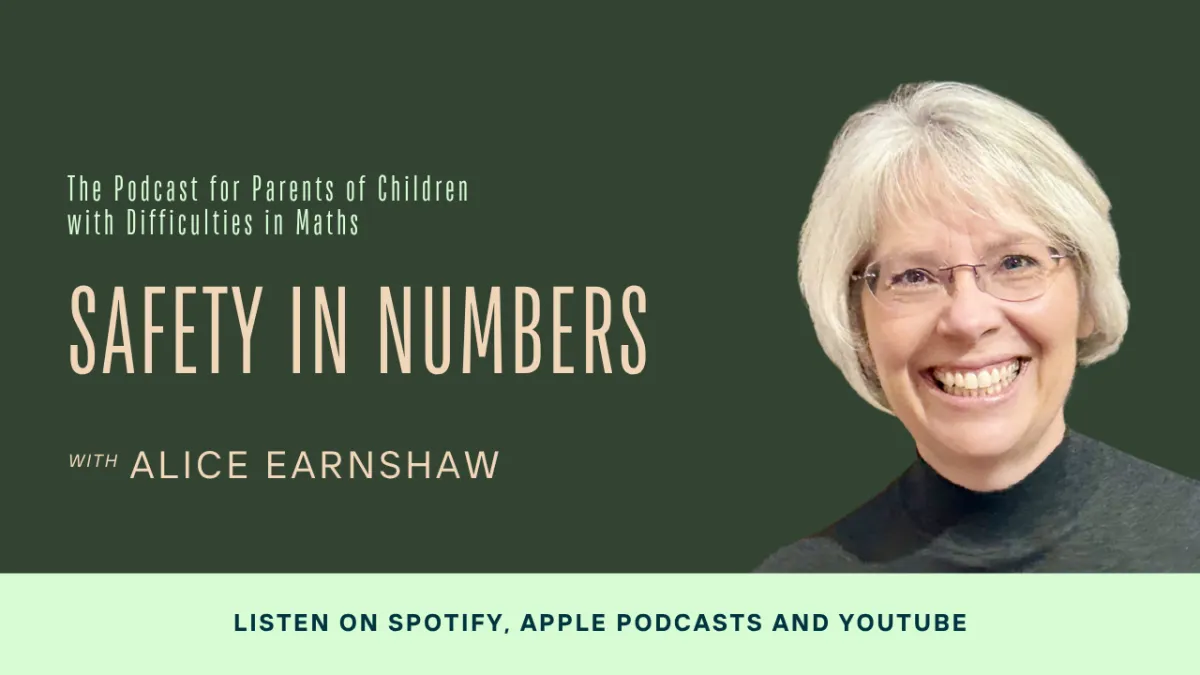
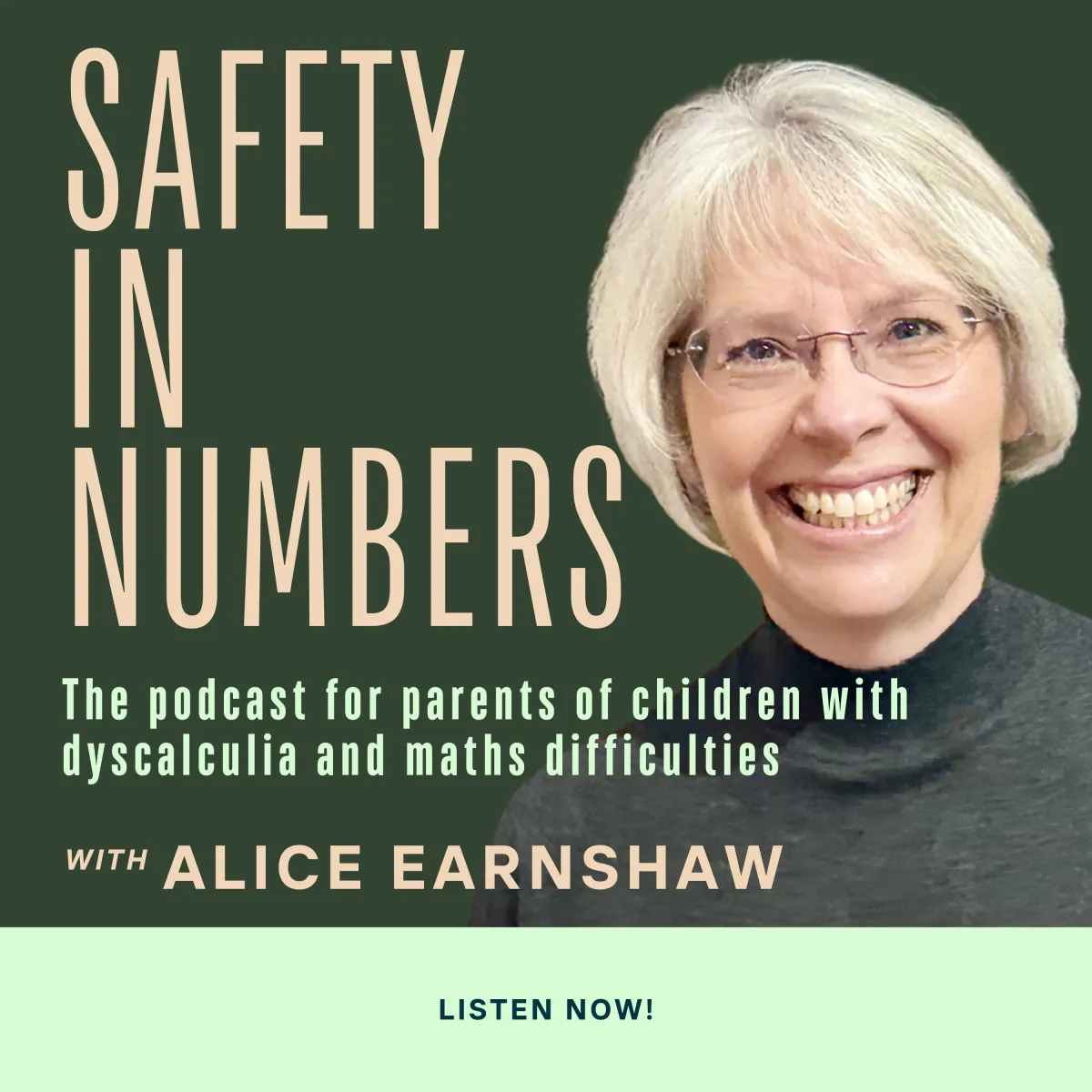
Hi, and thanks for visiting this site. I guess you've arrived here through either my podcast or my Facebook page or group, so you'll probably know a little about me already. I've worked in education for over three decades (I can't believe it either!) and throughout that time the focus has constantly been on maths education. I've been a primary school teacher, education researcher, teacher trainer and education consultant. When we started our family I was finishing off my PhD in Mathematics Education from the University of Warwick. My supervisor suggested I have a third child because the only time I seemed to be able to get stuff done was when I was on maternity leave. I told him that would be short term gain for long term pain! (We stopped at two ;-)) These days I am a maths consultant and specialist teacher and assessor for dyslexia and SpLD in maths / dyscalculia.
I created my Facebook page (Alice Earnshaw Dyscalculia Support), my Facebook group (Dyscalculia Support for Parents (UK)) and my podcast (Safety in Numbers) because: 1) I've met many parents who feel worried and uncertain about how to help their child or know what to do next; 2) I believe that dyscalculia and maths learning difficulties should be far more widely understood than they currently are; and
3) there is a real lack of accurate and easy-to-access information for parents of children with maths difficulties. I hope what I am producing will help you with your questions.
These companion guides are designed to give you something practical to take away from each episode. They will work best when you have listened to the podcast first.
How it works
Sign up once and receive a free companion guide by email as each new episode releases.
Listening after Season 1 has started?
No problem! You'll receive a link to all the existing guides once you have signed up.
About me
Hi, and thanks for visiting my site. I guess you've arrived here through either my podcast or my Facebook page or group, so you'll probably know a little about me already. I've worked in education for over three decades (I can't believe it either!) and throughout that time the focus has constantly been on maths education. I've been a primary school teacher, education researcher, teacher trainer and education consultant. When we started our family I was finishing off my PhD in Mathematics Education from the University of Warwick. My supervisor suggested I have a third child because the only time I seemed to be able to get stuff done was when I was on maternity leave. I told him that would be short term gain for long term pain! (We stopped at two.) These days I am a maths consultant, specialist teacher and assessor for dyslexia and SpLD in maths / dyscalculia.
I created my Facebook page (Alice Earnshaw Dyscalculia Support), my Facebook group (Dyscalculia Support for Parents (UK)) and my podcast (Safety in Numbers) because:
1) I've met many parents who feel worried and uncertain about how to help their child or know what to do next;
2) I believe that dyscalculia and maths learning difficulties should be far more widely understood than they currently are; and
3) there is a real lack of accurate and easy-to-access information for parents of children with maths difficulties.
I hope what I am producing will help you with your questions.
These companion guides are designed to give you something practical to take away from each episode.
They will work best when you have listened to the podcast first.